Showing posts with label Double Pinwheel String Quilt Tutorial. Show all posts

Monday, January 24, 2011

Double Pinwheel String Quilt Journals

 I am thrilled to have a very special guest post by Elizabeth of Such a Sew and Sew today!  She recently made a gorgeous quilt journal using my Double Pinwheel String Quilt Tutorial that she scaled down for her project.  When I saw it on her blog during her giveaway week, I was delighted and very moved by her gorgeous and crafty interpretation in the form of a journal.  Imagine my surprise when she sent me one!  I was overwhelmed!  And then curious as to how in the world she did it.  It's a work of art!

But I'll let Elizabeth tell the whole story and give you all the wonderfully detailed instructions on how you can make a Double Pinwheel String Quilt Journal too.  She is posting the same on her blog and agreed to "simulcast" it here.  Thanks so much, Elizabeth!

* * * * * * * * * * * * * * *


The imagination exercises a powerful influence over every act of sense, thought, reason — over every idea. –Latin Proverb

A long time ago, I decided to do the Free-Motion Quilt Along {which I'll eventually get started on, but that's another post for another day}. Part of the getting ready process was to get a notebook for jotting down ideas and drawing out designs. Well, I had this brilliant idea to make a notebook cover using P's gorgeous Double Pinwheel String Quilt tutorial. I'm a teensy bit obsessively creative and believe that if making one is good, then making two {or a hundred} is even better, right? Right. I decided that if I was going to go to the trouble of making one quilt journal for myself, while I was at it I probably ought to make one for the genius mastermind behind the beautiful design and then for good measure, I probably ought to make one to give away {which I did already}.

I set to work drawing out a design. I used P.'s template for the narrow pinwheels at full-size and cut it down so that it would come out at 2" finished for the entire block, but still use the angle that she used. I rummaged through my stash and pulled out all the bright, pretty fabrics I could find and started cutting strips. And then some other project had to be finished and this projected sat, completely neglected for a good four months. When I realized that I'd planned out a week-long blog anniversary/birthday giveaway in my head, but didn't actually have anything ready to give away, I decided it was time to dust this project off. About the same time I was getting ready to make the three journals, I found out who my buddy would be for this year's gift exchange for an on-line quilting group I'm in, and decided that a quilt journal would be the perfect gift for her. And so my plans for three quilt journals turned into four. Hooray for more January finishes!

My quilting is wonky {I obviously need to get back to that Free-Motion Quilt Along}, none of my centers match and I pieced the black pinwheels wrong and ended up cutting off all the points on them. I only realized that after I had all 12 pinwheels completely sewn together and there was no way I was going to unpick that many little bitty pinwheels and remake the 48 individual squares it took to make them. So I'm going with, I meant to do that. Other than that, I think they turned out pretty OK.

I used the same fabrics throughout, but each journal is a little different than the others because that's just how scrappy works out. I used some A.H. Arvika that I won during P.'s birthday giveaway for the inside cover and back and put in colored, tabbed pages to divide the book up for putting ideas into different categories. Each divider page has a little quilting quote on it.

There are 50 pages total in each notebook, 10 of which are double-sided graph paper, because I like to draw quilt designs out on graph paper.

I put bright red polka-dots on the back cover because that just seemed like the perfect finishing touch.

I really loved P's response to my journal giveaway, because what she didn't know was that one was already in the mail on the way to her house. When she received it, a little e-mail conversation ensued between us and she said she wanted to know the details of how I made it and wondered if I'd guest blog for her. I told her I was already planning a post on it. And here it is, simul-cast on her blog and mine.

Let's get to the nitty gritty. For a downloadable, printable version of this tutorial, click here. Here's what you'll need to make your own Double Pinwheel String Quilt Journal:
• 20 – 1" strings, at least 5" in length
• 45 – ¾" strings, at least 3½" in length
• 3 – 6¼" x 8½" rectangles of fabric for the inside covers and back of the journal
• A fat eighth each of solid black and solid white fabrics {or your choice of a light and a dark solid fabric}
• ¼ yard Pellon Peltex 72F II double-sided fusible stabilizer {I got mine at JoAnn's, but couldn't find it on their web-site}
Heat n' Bond Lite
• Chipboard Art Journal {Stampin' Up!® item #107065}
• Spiral Border Punch {Stampin' Up!® item #119872}
• Extra-Large Rounded Tab Punch {Stampin' Up!® item #119684}
• Crop-A-Dile {Stampin' Up!® item #108632}
• Craft knife with a sharp blade
• Pinking shears

If you're interested in making a journal with my pattern {which is sized for the Art Journal because I had them already on hand}, I just happen to know the cutest Stampin' Up!® demonstrator you can order your supplies from. Her name is Jenna and she would be more than happy to help you out. If you live in the US, you can place an order through her web-site or you can contact her directly via e-mail. If you live outside the US, visit Stampin' Up!®'s website to find a demonstrator in your own country.

Here is my design layout and the templates for the journal. When you print it out, make sure your printer is set to print at 100%.
Double Pinwheel String Quilt Journal

Use the templates to cut out the double pinwheels. Start with six white {or your choice of light solid} squares cut at 1⅞". Cut them in half on the diagonal and then use the template on the left to cut away the portion that will be the dark double pinwheel. If you need clarification, check out P.'s illustrated instructions. You'll be following the same steps, only on a smaller scale. The template eliminates the need for measuring the angle at which you cut away the excess fabric. Use a ¼" seam throughout.

To make the pinwheels, use the smaller template on the right to cut out 12 pieces from your black fabric {or your choice of light solid}. Make sure that you cut them all with the template right-side up. Use the line on the pattern as the grain line and cut your pieces on the grain.

Assemble the double pinwheel following P.'s illustrated instructions. Make sure you read the part about how to line up the smaller black piece on the white piece {hers are red and blue}, otherwise you'll end up cutting off all your points.

To get started piecing your strings, you'll need a foundation. P. used phone book pages and then tore them away when she was finished. I used foundation sheets, with the intention of leaving them in for extra stablity because of the small scale we're working with here. It did help with that, but even though the sheets are thin, they do add a bit of bulk and when you're working with small pieces, that makes things a little tough. So, it's your call if you want more stability with the foundation sheet or less bulk with old phone book pages {or newsprint} that you will remove later. Whatever your choice, you'll need one 3¼" x 8½" rectangle and six 2" squares.

Mark each foundation piece with a line on the 45˚ angle and begin piecing your string blocks, using the 1" strings on the 3¼" x 8½" rectangle and the ¾" strings on the 2" squares. If you need instructions on piecing your strings, refer to P.'s illustrated tutorial.

When you've finished piecing the string blocks, trim around the edges of all of the pieces and square up the squares to 1⅞" before cutting them in half on the diagonal. When you're finished, you will have 12 string triangles and 12 black and white triangles. Piece them together and then square them up to 1½".

Assemble the pinwheels, again referring to P.'s awesome illustrated instructions if needed. You will have three pinwheels when you finish, which should be squared up 2½".

From your white solid, cut six 1" x 2½" strips and four 1" x 3½" strips. Sew a 2½" strip to the left and right sides of each pinwheel. Then lay the blocks out in a column and sew a 3½" strip in between the blocks and on the top and bottom of the column.

The pinwheel section will be 3½" wide x 8½" tall. Sew this to the 3¼" x 8½" rectangle string block that you pieced earlier. Your patchwork piece will now be 6¼" x 8½", which gives you some wiggle room. Cut a piece of Pellon Peltex 72F II double-sided fusible stabilizer to match your patchwork piece. Use a rotary cutter and ruler so that it is nice and square. Make sure that the protective cellophane is on the back, facing the ironing board {otherwise you'll fuse the whole thing to your ironing board} and iron the patchwork onto the exposed fusible side of the stabilizer. Allow the journal-cover-in-progress to cool completely and then peel away the cellophane. Do all the decorative quilting you'd like on the journal cover, except for the outer edges and along the binder rings.

Turn the journal cover over and fuse the inside cover fabric to the back of the journal cover. Use pinking shears on the top, right and bottom edges and a rotary cutter on the left edge, to trim the cover to the finished size of 5¾" x 8¼".

Remove the chipboard covers from the Art Journal by opening the back cover and pulling the rings apart. Place the chipboard cover over the Double Pinwheel String Quilt Journal and mark the center of each hole along the left side of the journal cover. Use the ¼" punch on the outside handle of the Crop-A-Dile {you know, the one that punches through metal} to punch holes that the binder will go through. Then stitch all the way around the edges of the journal cover.

To make the back cover, fuse a piece of Heat 'n Bond lite to the back of the remaining two 6¼" x 8½" rectangles of fabric. Trim the pieces down to 5¾" x 8¼". Peel the backing off the fabric you chose for the inside and fuse it to the chipboard, making sure to put it on the inside of the back cover. Before you fuse the fabric to the other side, use the craft knife to cut away the fabric covering the holes where the journal binder goes through. Cut two parallel sides from the back and then flip the journal over and cut the remaining two parallel sides to open up the holes. Then fuse the outside fabric to the back cover and cut away the fabric that {again} covers the holes.

Using colored card stock, cut five divider pages at 5½" x 7¾". If you want, add a cute saying or quote to each divider page. I used the following:
In the crazy quilt of life, I'm glad you're on my block of friends. –Unknown
Our lives are like quilts – bits and pieces, joy and sorrow, stitched together with love.
–Unknown
When life gives you scraps, make a quilt. –Unknown
I cannot count my day complete 'til needle, thread and fabric meet. –Unknown
The only place where housework comes before needlework is in the dictionary. –Mary Kurtz

Use the rounded tab punch to make tabs for the pages. To help with even spacing, do the top and bottom tabs first, then center the middle tab directly between the two. Center the second tab between the top and the middle tabs and the fourth tab between the middle and bottom tabs. Use the Spiral Punch to make holes for the binder to go through. Insert the divider pages at intervals through the journal {I did 10 pages to a section}.

If you would like to add graph paper pages, right click on the image to the right and then choose Save Image As from the menu that pops up. Name and save the image to your hard drive. Open a new Word document and set the paper size to 5½" x 7¾", with top, bottom and right margins at .25" and right margin at .55". While you are in the Margins settings, go to the drop-down menu under the Pages heading and choose Mirror Margins. This will allow you to print the graph paper on both sides of the page and avoid printing in the area were the binder goes through the holes. Insert the graph paper image file into the document, setting the size at 7.26" x 4.77". Use the Position selector on the Picture Tools tab, to center the image on the printable area of the paper. I suggest printing a test page before you print on the Art Journal pages to make sure everything lines up right, based on how your printer feeds the paper through.

To reassemble the journal, place the pages onto the binder, right side up. Thread the journal cover through the binder, right side up. Put the back cover on top of the, with the inside back cover facing up. Push the binder back together and then turn the back cover around to the back. Voila. Your Double Pinwheel String Quilt Journal is finished. Now have lots of fun filling it up with beautiful quilt ideas!

Wednesday, August 18, 2010

Quilt Story

Hey, guess what?  My double pinwheel string quilt is being featured today on Quilt Story.  I'm pretty excited about it!  You can check it out here.

I have enjoyed reading about so many amazing quilters on Quilt Story over the past few months.  It is an honor to be among them.

I went for the scrappy look on this quilt, but I think it would look great in any number of other ways—all modern fabrics, a softer palette, etc.  There's a tutorial if you're inclined to make one:

Part 1 - Making the Template
Part 2 - Making the Blue and Red Units
Part 3 - Making the String-Pieced Squares
Part 4 - Putting in All Together

Thanks so much, Heather and Megan!  Keep the wonderful quilt stories coming!

Thursday, April 22, 2010

Tutorial Part 4 - Putting It All Together

We're in the homestretch!

Heading for the finish line on the Double Pinwheel String Quilt!

I had to Google how to spell homestretch (one word or two), and it's a racing term, of course. Did you know the Kentucky Derby happens next Saturday? I did not. Want to test your knowledge of the Kentucky Derby? Click here for a quiz. I got 5 of 10 correct, which is funny because I guessed at every single one.

Back to DPSQ:The Final Chapter. Let's sew this thing together, already!

We will be making 16 large pinwheel blocks, each consisting of four of the block units that you made in Part 3.

Step 1: Take four random block units that you made in the Part 3, and arrange them into a pinwheel.

Sew the top two block units together, then the bottom two. Press seams toward the red pinwheels. Since the paper has been removed and there are no more bias edges to worry about, I used a steam setting on my iron at this point, being careful to press gently and not stretch the pieces.

Step 2: Sew the two 2-unit sections together to make a block. Again, you will be pressing seams toward the red pinwheels, but first I am going to tell you how to do a little trick in the center of the horizontal seam you just sewed to make it lay flat. Working on the back of the block, unpick 2-3 threads in the center on two of the seams, and open the center (you should see a tiny pinwheel in the center). Finger press this area flat, then gently press with your iron on both the front and back of the block.

(Back of Block)

TIP: When sewing your two block units together in Step 1, don't backstitch the ends that will be in the center of the pinwheel block. You'll be less frustrated when you have to unpick a couple threads there in this step. Ask me how I know.

Repeat Steps 1 and 2 for all blocks. You will end up with 16 pinwheel blocks, each 15-1/2 inches square.

Step 3: Cut sashing strips and outer border from your remaining 3 yards of red fabric as follows:
  • Cut 10, 1-1/2 inch strips x width of fabric (WOF).

  • From the 10 strips you just cut, cut 20, 15-1/2 inch segments. These will be your vertical sashing strips between the pinwheel blocks.

  • Cut 4, 1-1/2 x 68-inch strips from LENGTH of fabric (LOF). These will be your horizontal sashing strips, above and below your rows of blocks. Your rows will be approximately 65 inches across, but we'll cut the sashing strips a bit longer and trim as needed.

  • Cut 4, 6-1/2 x 85-inch strips from LENGTH of fabric (LOF). These will be your outer borders. Again, we're cutting them a bit longer than necessary.
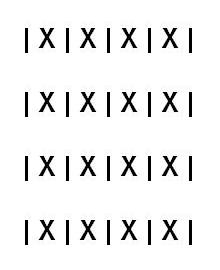
Step 4: Arrange blocks into four horizontal rows of four blocks each. Sew each row of blocks together with vertical sashing strips between blocks and on left and right ends of row as follows (where |=vertical sashing strip and X=pinwheel block):

Now, cut me some slack here; I don't have any other program (that I comprehend) to illustrate this, so you get my mad Paint grafik skilz.

Press seams toward red sashing strips.

Step 5: Sew long horizontal sashing strips between each row and at top and bottom as follows (where ------- = horizontal sashing strip):

Press seams toward red sashing strips.

Step 6: Cut 8, 2-1/2 inch strips x WOF from blue fabric for inner border. Join two strips end to end with a straight 1/4-inch seam. Press seam open. Repeat this with remaining strips so that you have 4 long, 2-1/2-inch strips for inner borders.

Step 7: Attach a blue border strip to the left and right sides of quilt top. (You all probably know how to measure for and attach borders, so I won't go into detail about that here.) Press seams toward blue border. Then attach a blue border strip to the top and bottom of quilt top. Again, press toward blue border.

Step 8: Attach red outer borders in the same manner as Step 7, i.e., to the left and right sides, then top and bottom. Press toward red border.

Step 9: Layer with backing and batting; quilt and bind as desired.

There's one more important step: Stand back and admire your beautiful quilt! Hooray! You deserve roses!


Anyone for a mint julep?

* * * * * * * * * * * * * *
Questions, comments, noted errors/omissions? Let me know, and I'll do my best to clarify.


Wednesday, April 21, 2010

Tutorial Part 3 - Making the String Pieced Squares

Guess what got delivered yesterday?

Oh, the irony.

This is my favorite part--the part where we piece the string units of the Double Pinwheel String Quilt. The part I actually did in between the other parts because I liked it so much. The relaxing and fun part. Have I used the word "part" enough in this paragraph? Part, part, part, part. Okay, I think so. Part.

Basically, you just sew, flip, and press until your paper is covered.

Paper? Yep, we're going to piece these on lightweight paper, which will be removed later while you watch Pride & Prejudice for the umpteenth time--or maybe that was just me. Phone book pages work great for this.

What kind of fabric for the strings? Anything your heart desires, just keep it 100% cotton. I used scraps. I think the beauty of string piecing is in the randomness. That means if you're an overthinker like me, you get permission to dial down your brain and just grab and go.

Let's get this party started!

Step 1: Cut a variety of fabrics into strips, or "strings." (I'm going to use those terms interchangeably here). Your strings should be between 1 and 1-1/2 inches, generally, just make sure each string is a uniform width from top to bottom. We are going to sew the strings on straight, not wonky. (Nothing against wonky; I just have a feeling it wouldn't work well here. If you try it and it rocks, by all means, let me know.)

Step 2: Grab your phone book and carefully tear out 32 pages. Trim each page to 8-1/2 inches square.

Step 3: Take one of your strings and place it right side up in the center on the diagonal of the paper. To keep it from shifting when you sew on the next string, pin along the left edge of the center string. This is probably the only pinning you'll need to do, just on this center string before you sew the first seam.

Step 4: Take a second string and place it face down (right sides together) on top of the center string, matching the right edge. Cut your fabric strip so it extends just a bit beyond the paper where you'll be sewing it on. Using a 1/4-inch seam, sew through both fabric and paper along right edge.

TIP: Use a shorter than usual stitch length when sewing the strings. This perforates the paper closer together and makes removing it easier. Backstitching at the beginning and end of your seam also helps keep the stitches from loosening at the edges when the paper is removed.

Step 5: Remove the pins on the center strip. Open the strip you just sewed so the right side is up, and press seam with a dry iron (no steam).

Step 6: Repeat this process on the opposite side of the center strip. Add a strip, stitch, flip open, and press.


Continue adding strips until the paper is completely covered.

Step 7: Turn fabric-covered square over and trim to 8-1/2 inches square, using the paper as a guide.


Step 8: Cut your string-pieced square in half, on the opposite diagonal as the strings are pieced, from corner to corner. Your ruler should be at a right angle to your seams, in other words.


You will end up with 64 string-pieced triangles. Aren't they pretty?

Now we're going to sew the string-pieced triangles to the blue and red units we made in Part 2. Leave the paper on yet for the next step. It helps stabilize the seam you are about to make.

Step 9: Pin a string-pieced triangle and a blue and red unit, right sides together, along the long edge of the triangles. This is a bias edge on the blue and red unit; try not to stretch it as you're pinning. Stitch.

Press seam toward blue and red unit.

Step 10: Remove paper from back.

TIP: It helps to fold the paper back against the stitching lines before gently tearing it away, like removing a check from a checkbook. This is a good project to do while watching TV, pretending to listen to your spouse or kids, etc. Not while driving though. Or bathing.

Step 11: Trim each one to 8 inches square.

TIP: Position the unit for trimming on your mat as shown, and trim the red pinwheel side (right side) first, then the lower edge. For some reason, this seemed to work best.

When you're done, you should have 64 of these for your quilt.

Next: Part 4 - Putting it all together!

Tuesday, April 20, 2010

Tutorial Part 2 - Cutting and Piecing Blue & Red Units

This is the second part of a tutorial on making the Double Pinwheel String Quilt. Part 1 can be found here. There will be 4 parts (I think) in all.

Now that we have our template, we're ready to start making the blue and red units.

Let's start with the BLUE FABRIC:

You will need a total of approximately 2-2/3 yards of blue fabric for this quilt, including what we're cutting today and the blue border later on.

Step 1: Cut 32, 8-1/2 inch squares from blue fabric.

Step 2: Cut each square on the diagonal into 2 triangles. (Seem familiar? This is going to be just like Steps 2-4 of Part 1, except that we're cutting our blue fabric to proper size, and we're going to use the other part of the triangle.)

Step 3: Take one of the blue fabric triangles you just cut and reposition it on the cutting mat so that the longest side of the triangle is at the bottom (toward you). This long side should measure 12 inches.

Mark a point 3-1/8 inches from the right-hand corner on the lower edge of the triangle.

Step 4: Position your ruler from this mark you just made, to the top point of triangle (Point A to Point B in photo). Cut along this diagonal line.


This time, we will only be using the larger portion on the left as our blue subunit. The small triangular pieces you cut off from the right side can be discarded or saved as scraps for another project.

Repeat this for all blue squares, cutting each square into 2 triangles, then trimming each triangle as above into a subunit. You will end up with 64 blue subunits.

TIP: Arrange all your blue squares right side up before cutting diagonally into triangles; also keep all your trimmed blue subunits right side up and oriented in the same direction, i.e., just as you trimmed them. It's easy (at least for me) to get confused if you start flipping pieces over.

From the RED FABRIC:

You will need a total of about 4 yards of red fabric for this quilt. Tracing the template for the inner pinwheels will require about 1 yard; the remaining 3 yards will be used for sashing and borders.

We are going to trace the template (made in Part 1) onto red fabric. However, there are a few KEY THINGS TO KNOW BEFORE PROCEEDING:

  • Do not flip your template piece over when you trace. All red pieces are traced with the same side of the template facing up--the side that you marked with the grain line in Part 1. You may want to write "This Side Up" on your template to remember not to turn it over to the other side when you trace it. If you do flip it, your red piece won't fit your blue piece when it's time to sew them together.
  • Red fabric should be traced with right side of fabric up. If you normally cut your fabric doubled with the fold along the edge, you will need to cut along the fold of 1 yard of the red fabric and stack both pieces right side up. OR, alternatively, you can trace your template pieces onto a single layer of red fabric right side up.
  • Grain line is important. As you trace the template, keep the long, marked grain line edge of the template piece along either the crosswise or lengthwise grain of the fabric. This will keep the finished blue and red unit from having an outer bias edge (which may stretch out of shape), and will make your piecing much easier.
Okay, now we're ready to go!

Step 5: Trace the template onto your red fabric. You will need to trace it 64 times if tracing on a single layer of fabric, or 32 times if tracing on a double layer.

I used a white tracing pencil, but you could use a washable fabric marker, etc.

Step 6: Cut out your red pieces as marked. You may want to use a scissors instead of a rotary cutter for this (I used both). A scissors will give you better control when cutting angles. You should have 64 identical red pieces. Again, it helps to stack all of these right side up to minimize confusion as you assemble them.

Step 7: Place a red piece onto a blue subunit as shown, right sides together. The important area to match is the lower edge. When done correctly, you will see a little blue triangle at the lower edge where the two pieces are slightly offset. The upper edge of the red fabric will extend beyond the upper point of the blue subunit. This is OKAY and as it should be. It will be trimmed later (don't trim now).

Sew a 1/4-inch seam along edge.

TIP: Start sewing from the lower edge to the upper point, with the red piece on the bottom as you feed it through your machine. This is a bias edge, so be sure not to stretch it when sewing or pressing.

Continue piecing all units together in this manner, for a total of 64 blue and red units.

Step 8: Press seam toward the red fabric on each unit. Use a dry iron setting, no steam.

I don't have a photo of a finished blue and red unit by itself, but you can get the idea below. Again, don't trim anything yet. We'll do that later when we trim these blocks to size.

Next: Part 3 - Making the string units and sewing the blocks.

Monday, April 19, 2010

Tutorial Part 1 - Making the Template


Thank you all so much for your lovely comments on the Double Pinwheel String Quilt. I really appreciate your kindness and enthusiasm!

As promised, I am going to post a tutorial for this quilt in several parts, starting today. We'll get the technical stuff out of the way first, making the template for the inner red pinwheel. This is not hard, it just involves drawing lines and cutting. Simple, really.

First, a note about fabric. I'm going to talk about blue fabric and red fabric, because that's what I used, but you can choose your own color scheme, of course. I would recommend Kona cotton for the solid fabrics. As I have mentioned, Candy Blue and Rich Red were what I used. As far as yardage, I am going to estimate you will need about 2-2/3 yards of the blue and 4 yards of the red. What fabrics you use for the string-pieced pinwheels is totally up to you. I used scraps in my stash, cut into 1 or 1-1/2 inch strips, or "strings."

So, here we go!

Part 1 - Making the Template

Let's start by making the template for the narrow inner (red) pinwheel on this quilt. For this, you'll need to make a template out of lightweight cardboard or some other such material. You will be tracing your template onto your red fabric, as I'll explain in Part 2, so it needs to be sturdy enough to trace around multiple times. In this example, I am using cardstock, but you could use the inside of a cereal box, etc.

Step 1: Cut a piece of cardstock into an 8-1/2 inch square.

Step 2: Mark a diagonal line from corner to corner. Cut along diagonal line.

Step 3: Take one of the triangles you just cut and reposition it on the cutting mat so that the longest side of the triangle is at the bottom (toward you). This long side should measure 12 inches.

Then mark a point 3-1/8 inches from the right-hand corner on the lower edge of the triangle.

Step 4: Using your ruler, draw a diagonal line from this mark to the top point of the triangle. Cut along line.

Step 5: Place the smaller triangular piece you just cut off the right side onto another piece of cardstock, and trace it. Important: Do not flip the piece over that you are tracing. I'm using a different color cardstock here, for illustration purposes, but you can use whatever you have.

Step 6: Add 3/8 inch along the right (longest side) of the traced triangle. Draw this line.

Step 7: Mark grain line along the long edge. Trust me, it's important!

Step 8: Cut out your cardboard template along the outermost lines you just drew.

And there you have it--the only template you will need for this quilt! You can get rid of all your other cardboard pieces and scraps except for this one piece.

Next: Part 2 - Cutting and piecing the blue and red units.