We took a road trip the first week of October, which came about in part due to a shift in employment for me. One of my part-time jobs was ending because the doctor was retiring, but before I ramped up my hours on my other job, Norm and I decided to hit the road.
I'd never been out in the direction of Mount Rushmore, something I've always wanted to see, and it seemed a driveable distance, given our timeline, and a decent time of year to go. So we headed west!
Some of the highlights were:
Badlands National Park...
Mount Rushmore and Crazy Horse Memorial...
Devil's Tower, Wyoming...
The Mammoth Site in Hot Springs...
There were so many other interesting things to see. I wanted to learn more about Native American culture, so we stopped at the Akta Lakota Museum and Cultural Center on the grounds of the St. Joseph Indian school at Chamberlain, South Dakota. Fascinating history in the exhibits and information as we toured the museum.
I found particularly interesting to read about the history of quilting among the Sioux culture.
After we left the museum, we paused to see the new 50-foot sculpture installed along I-90 near Chamberlain. It's called "Dignity" and depicts a Native young woman receiving a star quilt. According to sculptor Dale Lamphere, “Dignity represents the courage, perseverance and wisdom of the Lakota
and Dakota culture in South Dakota. My hope is that the sculpture might
serve as a symbol of respect and promise for the future."
It was 37 degrees and raining steadily when I hopped out and took this photo. But it's a beautiful and inspiring piece, rain or shine.
There were a couple stops at quilt shops along the way, notably Calico Hutch in Hayward, MN and Heartsong Quilts in Hot Springs, SD. I could have spent hours (and more money) at both stores, they were fantastic! As time was limited and we had to be moving on, I was happy to find out I could visit them anytime online.
I did some stash replenishing between those two, as well as shopping the 50% off clearance fabric sale at Jo-Ann on Columbus Day when I got home.
I addressed my deficit of low volume fabrics in the stash, and I think I did okay.
The last hotel we stayed at on the way back, Microtel in Rochester, MN, had some interesting carpeting in the hallway.
Quilt inspiration is everywhere!
Showing posts with label Culture. Show all posts
Sunday, October 16, 2016
Thursday, July 25, 2013
Oh, the Paine
One of the day trips we planned for this summer was to visit the Dale Chihuly Venetians exhibit at the Paine Art Center and Gardens in Oshkosh, Wisconsin. We went there last Saturday, and it was exquisite!
And here is where I wish I had stunningly beautiful photos of the Chihuly Venetians on display, but on arrival we were advised that no indoor photography was allowed.
In a word: Bummer.
There was camera surveillance and official looking people roaming the gallery, so it's not like I could even sneak one (not that I would have...okay, maybe). But come on, no photos? Ugh. And did I mention bummer?
So this middle-aged gal, who can barely remember what she had for dinner last night, was forced to stare intently at as many exhibits as I could to try to burn them into memory. Because who knows when, if ever, I will see them again, right? Unfortunately, that does you no good, dear blog reader, so here is a representative sample.
This image is from the website of the George R. Stroemple Collection, of which part is on display at the Paine. You can follow that link if you'd like to see more, although I didn't recognize any of them as being the exact ones I saw in Oshkosh. There must be a ton more; either that, or my memory is worse than I thought.
In the center of the gallery were Chihuly's Laguna Murano chandeliers, also a part of the Stroemple collection. Simply breathtaking to see up close (and they were arranged more dramatically than depicted here).
All bellyaching aside about the restrictions (and I totally get the reasoning), it was a wonderful exhibit. If you live near or are traveling through Wisconsin anytime this summer, consider a stop in Oshkosh to experience close up a fabulous Chihuly blown glass collection.
And the Paine is a marvelous place to visit in and of itself. Outside (where you can take all the photos you want, of course), the gardens and grounds are a joy to explore.
The mansion was built by a lumber baron in the late 1920s to early 1930s. In addition to the art galleries, the house serves as a museum. I see something new every time I go (and that's been at least a half dozen times through the years). I love the place.
And love was definitely in the air, as there were two weddings taking place on the grounds on Saturday. We sort of felt like wedding crashers, but since the gardens stay open to the public, we did our looky-loo thing while they did theirs, and just tried to avoid bombing the wedding photography.
Kitty-corner across the street is the Oshkosh Public Museum, and we also ventured over to check out the steampunk exhibit.
Norm is into the steampunk thing. Me, not so much, although it's cool to see the unique contraptions and costumes.
We toured the entire museum, which is laid out very well with interesting interactive displays throughout.
Had to get a picture of this Victorian table made of spools!
How about you? What floats your boat as a summer day trip?
And here is where I wish I had stunningly beautiful photos of the Chihuly Venetians on display, but on arrival we were advised that no indoor photography was allowed.
In a word: Bummer.
There was camera surveillance and official looking people roaming the gallery, so it's not like I could even sneak one (not that I would have...okay, maybe). But come on, no photos? Ugh. And did I mention bummer?
So this middle-aged gal, who can barely remember what she had for dinner last night, was forced to stare intently at as many exhibits as I could to try to burn them into memory. Because who knows when, if ever, I will see them again, right? Unfortunately, that does you no good, dear blog reader, so here is a representative sample.
This image is from the website of the George R. Stroemple Collection, of which part is on display at the Paine. You can follow that link if you'd like to see more, although I didn't recognize any of them as being the exact ones I saw in Oshkosh. There must be a ton more; either that, or my memory is worse than I thought.
In the center of the gallery were Chihuly's Laguna Murano chandeliers, also a part of the Stroemple collection. Simply breathtaking to see up close (and they were arranged more dramatically than depicted here).
All bellyaching aside about the restrictions (and I totally get the reasoning), it was a wonderful exhibit. If you live near or are traveling through Wisconsin anytime this summer, consider a stop in Oshkosh to experience close up a fabulous Chihuly blown glass collection.
And the Paine is a marvelous place to visit in and of itself. Outside (where you can take all the photos you want, of course), the gardens and grounds are a joy to explore.
The mansion was built by a lumber baron in the late 1920s to early 1930s. In addition to the art galleries, the house serves as a museum. I see something new every time I go (and that's been at least a half dozen times through the years). I love the place.
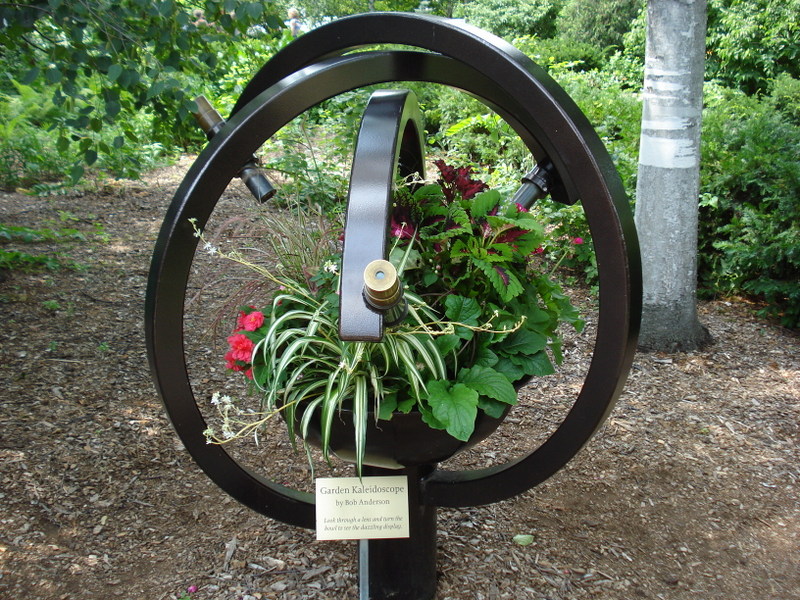
| Through the lens of the Garden Kaleidoscope (above). |
| Oshkosh Public Museum |
Norm is into the steampunk thing. Me, not so much, although it's cool to see the unique contraptions and costumes.
We toured the entire museum, which is laid out very well with interesting interactive displays throughout.
Had to get a picture of this Victorian table made of spools!
How about you? What floats your boat as a summer day trip?
Monday, July 8, 2013
Things, Continued
Thanks to everyone who chimed in with an opinion as to the background in the previous post. I went with D and have it appliqued on now.
It feels like it needs something else, but I can't put my finger on what. I'll let it sit for a while to chill. Maybe an idea will percolate.
I also liked C, the pool-like aqua background, but Norm was not a big fan. Something else I hadn't initially considered was that it will hang on a sage green wall, so the color clash may have been a bit much with the aqua.
I immediately thought of a quilt block when I saw this colorful shield at the entrance. There was another one over the main building/gift shop in a different style, but I forgot to get a picture of that one or ask the story behind them.
Our tour guide called in a young man whose job was to demonstrate Native American fire starting using a traditional method. He used a bow around which a pointed dowel or drill-like piece of wood is wrapped in a cord. He held a stone in his left hand at the top of the drill and moved the bow back and forth with his right. The reciprocating motion by drawing the bow back and forth causes friction and ultimately hot embers on the lower end of the drill, which then ignite the tinder around and beneath it.
Traditional tinder was frayed cedar, but they have since switched to using jute (from the local hardware store), both for demonstrations and also in the fire-starting kits they sell.
In the time it took me to formulate that explanation and peck it out on the keyboard, this guy could have started three fires. He was a pro!
The Ojibwe of Lac du Flambeau traditionally spearfished by torchlight from canoes. Ojibwe spearfishing continues to the present day and has been the subject of controversy over treaty rights.
Lac du Flambeau translates to "Lake of the Torches" (also the name of the casino on the rez).
Here is a traditional type birch bark canoe.
I really enjoyed seeing the workmanship of the canoe. Our tour guide told us what Native people used to sew with as lashing—pine roots! You know, those things you trip over when you walk in the woods. Apparently, they made good, strong "thread" for heavy-duty jobs of this sort.
The torch is made of birch bark and pitch.
It was interesting to learn how canoes were stored during the winter. The tour leader asked if we had any guesses. I guessed in the trees - wrong answer. They were pulled out to the middle of the lake, loaded with stones, and sunk! There they would remain, safe from being stolen and preserved below the ice in the depths of the frigid waters for months on end.
We heard about wild rice harvesting by the Ojibwe, and how young children were recruited to "dance" on the grains to break down the outer husks. This was done inside a special pit while the elders told stories (because after about an hour, kids being kids, it wasn't so much fun anymore). Then the rice was tossed in the air over a blanket or large piece of leather to separate the chaff.
The tour guide shared a wild rice recipe "so easy you don't even have to write it down." Maybe not, but I heard someone repeating it into their smartphone behind me. I am making a version of it in the oven as I type this post and I can smell it cooking. I'll give you the details later, if it turns out (just checked it and it's got a ways to go).
These war clubs look like they could do some damage, if necessary.
There were feathers on the end of one of the clubs (cut off in my pic). The guide told us how they would sneak into the camp of another tribe at night, brush the feathers across the cheek of a sleeping person, and take something belonging to them. If no one woke to the feather's touch, and on discovering the next day that something had been stolen, the tribe would lose face. Apparently, gaining it back meant doing the same to the first tribe. Ah, the games people play.
We heard about wigwam building and saw various summer and winter camp re-creations. Can you imagine cooking in a winter kitchen like this?
Did you know the toboggan was the traditional form of transport for northern Native people? Same thing with the snowshoe, invented by North American indigenous people.
Here's your below-frost-level refrigerator, called a winter cache.
These winter wigwams could be heated with a small fire to a toasty 68-70 degrees. I didn't ask whether the bear skin was used for decoration or insulation. Maybe both.
In the spring, maple sap was boiled down into lumps of maple sugar and these were saved for the next winter. When stored food was scarce or hunting was poor, it was often this supply of maple sugar that got the tribe through the end of a tough winter. It takes 40 gallons of sap to make 1 gallon of maple syrup, so you can imagine that's a whole lot of maple trees to be tapped to make maple sugar.
If you ever get to northern Wisconsin, I highly recommend a visit to Waswagoning. It was a fascinating glimpse into traditional Ojibwe culture.
So that's a little taste of the tour. How about the wild rice dish?
It's later now and I've eaten it for supper and it was very good. It took quite a while for the rice to get tender in the oven, so if I make it again, I will probably cook it on top of the stove and add cooked chicken toward the end of the process.
Here's what I did.
Ingredients:
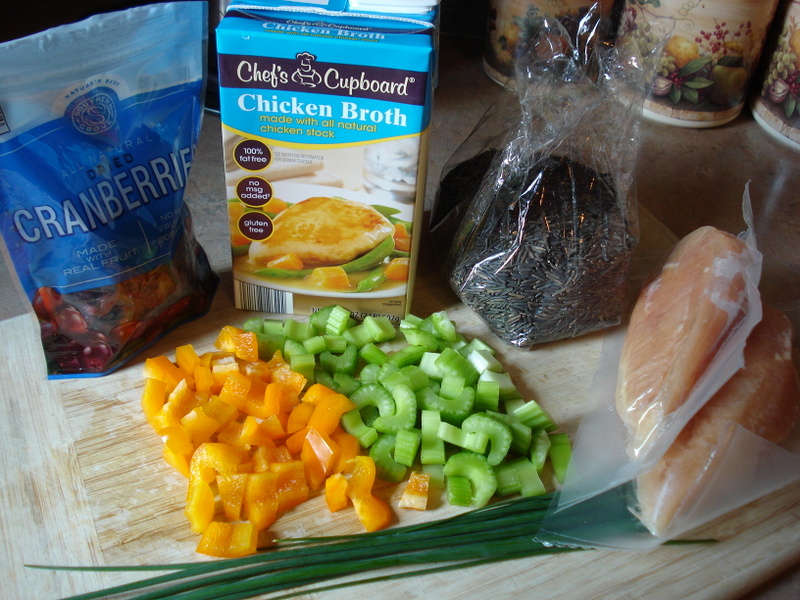
1 cup wild rice
2 cups chicken broth + 1 cup water (total 3 cups liquid), heated to boiling
1/2 cup dried cranberries (or you could use 1 cup of fresh cranberries)
2 boneless chicken breasts, cut into bite-sized pieces
2 ribs of celery, chopped
1/2 sweet pepper, chopped
chopped fresh chives
1-2 Tablespoons butter (or butter substitute)
Preheat oven to 350 degrees. Layer everything in a large casserole dish and pour the hot chicken broth/water over the top. Cover and bake until rice is tender and most of the liquid is absorbed. This took 1-1/2 hours for me. Check it after about an hour and give it a stir. If the rice isn't fully cooked yet, return it to the oven for a half hour or so.
(Write a long blog post, edit photos, talk on the phone...)
Then enjoy!
It feels like it needs something else, but I can't put my finger on what. I'll let it sit for a while to chill. Maybe an idea will percolate.
I also liked C, the pool-like aqua background, but Norm was not a big fan. Something else I hadn't initially considered was that it will hang on a sage green wall, so the color clash may have been a bit much with the aqua.
* * * * *
Picking up on our trip to the recreated Ojibwe village at Waswagoning, which we toured while on vacation last week.I immediately thought of a quilt block when I saw this colorful shield at the entrance. There was another one over the main building/gift shop in a different style, but I forgot to get a picture of that one or ask the story behind them.
Our tour guide called in a young man whose job was to demonstrate Native American fire starting using a traditional method. He used a bow around which a pointed dowel or drill-like piece of wood is wrapped in a cord. He held a stone in his left hand at the top of the drill and moved the bow back and forth with his right. The reciprocating motion by drawing the bow back and forth causes friction and ultimately hot embers on the lower end of the drill, which then ignite the tinder around and beneath it.
Traditional tinder was frayed cedar, but they have since switched to using jute (from the local hardware store), both for demonstrations and also in the fire-starting kits they sell.
In the time it took me to formulate that explanation and peck it out on the keyboard, this guy could have started three fires. He was a pro!
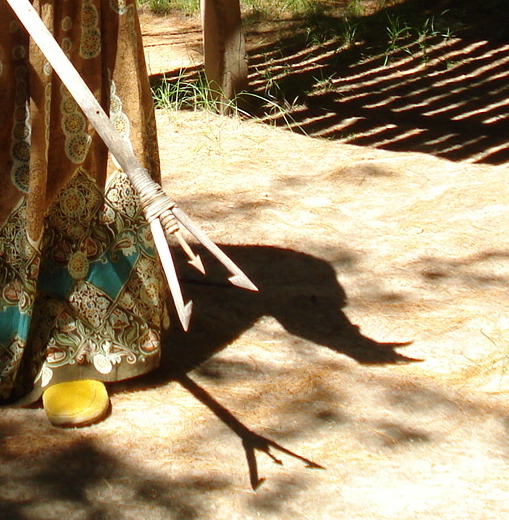
The Ojibwe of Lac du Flambeau traditionally spearfished by torchlight from canoes. Ojibwe spearfishing continues to the present day and has been the subject of controversy over treaty rights.
| Ojibwe fishing spear |
Here is a traditional type birch bark canoe.
I really enjoyed seeing the workmanship of the canoe. Our tour guide told us what Native people used to sew with as lashing—pine roots! You know, those things you trip over when you walk in the woods. Apparently, they made good, strong "thread" for heavy-duty jobs of this sort.
| Pine roots - used for sewing |
It was interesting to learn how canoes were stored during the winter. The tour leader asked if we had any guesses. I guessed in the trees - wrong answer. They were pulled out to the middle of the lake, loaded with stones, and sunk! There they would remain, safe from being stolen and preserved below the ice in the depths of the frigid waters for months on end.
| Fish trap |
The tour guide shared a wild rice recipe "so easy you don't even have to write it down." Maybe not, but I heard someone repeating it into their smartphone behind me. I am making a version of it in the oven as I type this post and I can smell it cooking. I'll give you the details later, if it turns out (just checked it and it's got a ways to go).
These war clubs look like they could do some damage, if necessary.
There were feathers on the end of one of the clubs (cut off in my pic). The guide told us how they would sneak into the camp of another tribe at night, brush the feathers across the cheek of a sleeping person, and take something belonging to them. If no one woke to the feather's touch, and on discovering the next day that something had been stolen, the tribe would lose face. Apparently, gaining it back meant doing the same to the first tribe. Ah, the games people play.
| Spears on side of wigwam |
| Winter cooking area |
| Underground cache for food storage |
These winter wigwams could be heated with a small fire to a toasty 68-70 degrees. I didn't ask whether the bear skin was used for decoration or insulation. Maybe both.
In the spring, maple sap was boiled down into lumps of maple sugar and these were saved for the next winter. When stored food was scarce or hunting was poor, it was often this supply of maple sugar that got the tribe through the end of a tough winter. It takes 40 gallons of sap to make 1 gallon of maple syrup, so you can imagine that's a whole lot of maple trees to be tapped to make maple sugar.
If you ever get to northern Wisconsin, I highly recommend a visit to Waswagoning. It was a fascinating glimpse into traditional Ojibwe culture.
So that's a little taste of the tour. How about the wild rice dish?
It's later now and I've eaten it for supper and it was very good. It took quite a while for the rice to get tender in the oven, so if I make it again, I will probably cook it on top of the stove and add cooked chicken toward the end of the process.
Here's what I did.
Ingredients:
1 cup wild rice
2 cups chicken broth + 1 cup water (total 3 cups liquid), heated to boiling
1/2 cup dried cranberries (or you could use 1 cup of fresh cranberries)
2 boneless chicken breasts, cut into bite-sized pieces
2 ribs of celery, chopped
1/2 sweet pepper, chopped
chopped fresh chives
1-2 Tablespoons butter (or butter substitute)
Preheat oven to 350 degrees. Layer everything in a large casserole dish and pour the hot chicken broth/water over the top. Cover and bake until rice is tender and most of the liquid is absorbed. This took 1-1/2 hours for me. Check it after about an hour and give it a stir. If the rice isn't fully cooked yet, return it to the oven for a half hour or so.
(Write a long blog post, edit photos, talk on the phone...)
Then enjoy!
Subscribe to:
Posts (Atom)